
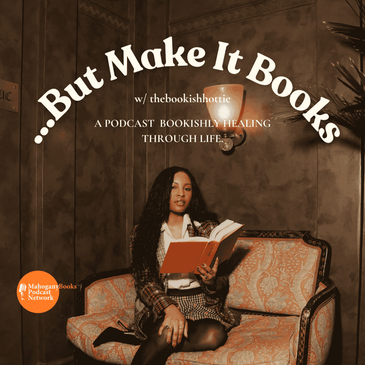

Join Niccara as she welcomes award-winning author, journalist, and two-time Emmy Award-winning television producer Nikesha Elise Williams to the pod! We talk about her sweeping debut with Simon & Schuster, Seven Daughters of Dupree: a multigenerational saga tracing seven generations of Black women from 1860 to the present day, bound together by legacy, love, loss, and a curse that only a daughter can break. We get into the enslaved ancestor whose story sets everything in motion, why hair is both inheritance and survival in this novel, what secrecy truly costs the women of this bloodline, the intimacy Black people have always had to carry about white folks just to stay safe, and the quiet call of the land pulling Black people back to the South. Plus Nikesha reads from the prologue and we spiral beautifully into hot combs, Saturday nights, and every Black girl's sensory memory.
Perfect for readers who love multigenerational Black family sagas, stories rooted in the Black South, and honest reckoning with what we carry, what we keep secret, and what we dare to pass on differently. Make sure you pick up The Seven Daughters of Dupree wherever you get your books, and run it up!
Follow & Find Nikesha Elise Williams: @nikesha_elise | newwrites.com | Black & Publish Podcast
Follow Us: @butmakeitbookspod | @thebookishhottie | bookishlyhealing.com
Shop With Us: Use our Mahogany Books link with code BMIB
Don't forget to rate, subscribe and review!
Keeping it real...but make it books. Peace y'all
Mentioned in this episode:
African Ancestry
We are the pioneers of genetic ancestry tracing for Black people globally, reconnecting you to your specific African roots–the country and the people. Our scientists compare your DNA markers to the largest African reference database in the world in order to find your African origin up to 2000 years ago.
The Seven Daughters of Dupree Pre-Order Offer
Nikisha Elise Williams, the host of the Black and Published podcast, is celebrating the release of her forthcoming novel, The Seven Daughters of Dupree. This historical fiction novel is about the secrets kept between mothers and daughters over the course of seven generations and is told backwards in time from 1995 to 1860. The Seven Daughters of Dupree will be released on January 27th, 2026, but is available for pre-order now at MahoganyBooks.com. Please consider pre-ordering The Seven Daughters of Dupree today.
African Ancestry
We are the pioneers of genetic ancestry tracing for Black people globally, reconnecting you to your specific African roots–the country and the people. Our scientists compare your DNA markers to the largest African reference database in the world in order to find your African origin up to 2000 years ago.
[00:00:01] This is the Mahogany Books Podcast Network. What's good, family? I'm Nikesha Elise Williams, the host of Black & Published Podcast and the author of the forthcoming novel, The Seven Daughters of Dupree. This historical fiction novel is about the secrets kept between mothers and daughters over the course of seven generations and is told backwards in time from 1995 to 1860.
[00:00:27] The Seven Daughters of Dupree will be released on January 27, 2026, but is available for pre-order now. So if you can, please consider pre-ordering The Seven Daughters of Dupree today. Your Ancestor's Story is proof that strength and dignity endure even when everything else is taken away. When it comes to honoring that legacy, your privacy should never be in question.
[00:00:53] At AfricanAncestry.com, your story and your information belong to you. We destroy every DNA sample and never sell or share your data with anyone. Discover where in Africa your story began accurately and safely with AfricanAncestry.com. Books have always been more than pages.
[00:01:18] They're how we process, they're how we heal, how we find ourselves in someone else's story. That's what this show is built on. Hey y'all, I'm Nakara and you're listening to Dot Dot Dot But Make It Books. A podcast where we're bookishly healing through life, one conversation at a time. Every episode, I'm sitting down with the authors, booksellers, and book lovers who are shaping the literary world. The people behind the pages and the passion that keeps this community alive.
[00:01:46] So hey, if this show has ever handed you your next favorite read, made you feel seen, or reminded you why you fell in love with books in the first place, do me a favor. Rate us, subscribe, leave a review. It literally takes two minutes and it means everything. It's how we, this small indie podcast, grows this community and gets these conversations in front of more readers who need them. Now let's get into it.
[00:02:18] Hey everyone and welcome to another episode of Dot Dot Dot But Make It Books, a podcast where we're bookishly healing through life. I'm your host, Nakara Campbell, and I am super blessed to be in the space, in place with my sister in pod, sister in books, sister in things. Hey. Hey girl, how you doing? Hey, I am good. Good. Good. We love to ask people how are they feeling. So how are you feeling? In this present moment?
[00:02:48] Yeah. I feel good. Honestly, I do. I feel really good. Good. I love that. So we like to call our icebreaker our snowball cause Baltimore. What has been your favorite moment from the tour so far? Oh my gosh. Just seeing the people, you know, this is my traditional big five debut novel.
[00:03:18] And I say that because I was indie for years before and I would try to do events or try to like get my name out there and stuff like that. And there might be six people in the room, 12 people in the room. So to go on a tour sponsored by my publisher, okay?
[00:03:35] And to see crowds of people that I don't know personally all the time or that had heard about the book, got the book, were excited about it, or listened to the podcast or have seen me on social media and they're like genuinely excited about the work and about meeting me. Like it's so surreal. And that's been the greatest joy of the entire tour process, having the conversations about the work and meeting people who are really, you know, like in there for it.
[00:04:05] Yeah. And you deserve it. And I'm really happy that you get to have your moment. It's very exciting to watch. Thank you. It is. It's very exciting. So if you guys don't know who I have the fortunateness to be blessed in the space with all of the melanin, we have Nikesha Ellis Williams, an award winning author. Okay. Journalist and two time Emmy. Okay. She's an Emmy award winner. You guys television producer.
[00:04:35] She is the host and executive producer of black and publish a podcast dedicated to amplifying black voices and literature. Her previous novels include for women and beyond bourbon street. So make sure you guys pick that up as well. Her highly anticipated debut with Simon and Schuster, seven daughters of Dupree is sweeping multi-generational saga, tracing seven generations of black women from the 1960s to the present day bound together by legacy, love, loss, and a curse that only a daughter can break. Again, welcome to the pod.
[00:05:05] Thank you for asking me. Whew. Again, I said it before we started, you wrecked me. Um, I felt like I said this way since Isaac song, um, by Dr. Daniel black. And I just felt like in kin.
[00:05:20] So it's like definitely up there for me and like empathy of our parents and what they have endured, but seven daughters spans from 1860 to 2000 and twenties, seven generation of women, one bloodline. What was the seed of the story and where did the Dupree's begin for you? Everything started with Tati. Yeah, everything started with Tati.
[00:05:47] So the first character that you meet, the first daughter that you meet is Tatiana. Um, and it really started with her and wanting to write a novel about a girl who didn't know her father as a way for me to work out my own complex relationship with my own dad. But the difference is, and that was immediate for me on the pages. I was writing the novel, which allowed the page to be a place to play was that I did grow up with my father. I do know who he is. I mean, I can name him.
[00:06:16] I can pick him out in the lineup, all the things that Tati cannot do. And so the feelings that I have, she does not have where I have a complex relationship with my dad that I did write, you know, like angsty 14 year old girl poetry about Tati doesn't have that. She idealizes her father. She has romanticized him because of his absence. And the anger that she does have is directed toward the people who are around her, namely her mother and her grandmother.
[00:06:43] And so I was able to give Tati my interiority and emotionality from my younger self without it being me and being very clear that this is a work of fiction separate and apart from the work that the author, Nikisha, has to do in real life. And so it all started with her and grew from there. I really do love it.
[00:07:07] And you, it's something that I'm exploring a lot within your text, but then also if we look at Ken as well, it's like in this book, we're not dealing with motherless daughters. We're dealing with only really like mothers in a way. I mean, the dads are there except for Tati, but they're like just supporting for the, you know, yeah, they're like side characters a little and it's okay.
[00:07:37] Cause like, honestly, like a side plot, but you know what? That's fine. That's fine. Cause Samson sound like a whole snack, but anyway, um, well, you know, he did have Ruby out there on that beach. He had me out on the beach. He had me on the beach. Take my hand. Okay. Take, take my hand. Lead me down to the pastures of the sand. Okay. I don't even care. I don't care. Take me, Samson. Take me. I'm yours.
[00:08:05] So this is your first traditionally published debut and you have it with Simon and Schuster, but you're again, you're not a new writer. You've had four women beyond Bourbon street. You have a host of books. Honestly, you have a lot, you have a catalog. How does this book feel different? Like a culmination or something else entirely? Does it feel different at all? It's a culmination, but it's also a beginning.
[00:08:31] Um, you know, I started working on my first novel that became my first self published novel in 2013, maybe even before then, cause it started off as a short story I wrote in 2010. And so I've wanted to be traditionally published by a big five publisher since, you know, I graduated from undergrad with my little undergrad English creative writing thesis. Okay.
[00:08:58] Like I've wanted it for that long and I did get close with myself, my first self published novel, but at the end of the day, there was no sale. And so I did decide to do it on my own. And for a while found success of my own kind in making in self publishing. There was a freedom to being able to do it myself, to being able to not have to answer to anyone else and really explore my imagination,
[00:09:25] hone my craft, really work my pen and get my voice together in a way that traditional publishing does not allow for debut. I think. And so the fact that I self published five novels in a poetry collection between 2017 and 2020 was a freedom. And then that led to my first, I guess, traditional deal, but a smaller level.
[00:09:55] It's where University Press, my very first nonfiction book, the only nonfiction book I've ever written. Mardi Gras Indians about the black masking Indians of New Orleans. And that came to me through public writing. I'm a journalist by trade. So when I left television in 2019, I freelanced for three years. And one of the pieces that I that I had written caught the eye of an editor at LSU Press. And they were like, you want to write a book for us? And I was like, absolutely. And they were going to pay me for it. And I was like, OK, well, let's do this. Right.
[00:10:24] And so all of that has led to what is now the Seven Daughters of Dupree. And the reason that I tried traditional publishing for this book specifically, again, was that it got bigger than what I thought I could hold on my own. And even though I had a team, like I had designers, I had two different types of editors and would be very rigorous and diligent about making myself publish work as good as it can be.
[00:10:53] And that it would hold up next to anything on any shelf in any store. And you would never know. This story just got so, so big. And my life had changed a lot. I went from a married mother of one to a divorced mother of two. It just things happen. And so this particular book needed more than I alone could give it. It needed a team.
[00:11:19] And so I'm so glad it found the team that it needed. And so it is very much the culmination of all the work I had done before. But now it's also the beginning of a brand new chapter. Oh, I love that. And it's like so such a through line of the text of what you're saying right now in the in the end of the book, like in the journey of the book.
[00:11:44] It's very much like a coming of, of you, of a new beginning for you of like what you're bearing and what you let go. And I felt like a lot of women finally were able to let go at the end too. I hope so. I think so. I think so. I'm gonna have hope that they did. I think they did. Before we go any further, would you mind giving us an excerpt if you have it on hand? Not at all. I do have it right here. No.
[00:12:14] Yes. So I'll just read from the beginning. Okay. I'll read from the prologue and a little from chapter one. Is that okay? Yep. That is perfect. Okay. Prologue. They cut off her head because she ran. But who could know? Certainly not Tati. She was looking for her daddy. Her mama, Nadia, wouldn't tell her. Gladys, her Mimi, wouldn't tell her either.
[00:12:44] So she searched for him. She didn't know to search for anyone else. It wasn't like there was a burial or body. No coffin, no cemetery. But in a way she found her. In fact, she found them all. Including her daddy. In the kitchen table whisperings and the basement murmurings. Where her mother used a hot comb to press out her hair every Saturday night. Part one. Questions.
[00:13:13] March, 1995. The noxious scent of burnt hair and relaxer cold cocked Tati with a closed fist. Singeing her nose hairs as she made her way into the basement. A yellow neon sign that read, Nadia's Nubian Salon. Hung on the wall of the landing. Led the way for customers who entered through the back door. Not that Mimi ever came that way. She insisted on coming through the front. As soon as she crossed the threshold,
[00:13:42] her eyes roamed as her gloved hands swiped across furniture that was neither dusted nor polished. And her feet traversed the floor that wasn't mopped. For the unwashed dishes in the sink. She shook her head and kissed her teeth. Behind the heavy basement door, Mary J. Blige's My Life album provided the soundtrack for the Sunday morning appointment. Nadia sang along in her own version of praise and worship. She didn't abide no gospel.
[00:14:10] And since all the R&B stations got holy from 7 to noon, Nadia was her own DJ. Despite Mimi's misgivings. The elder woman never said anything. The only indication of her displeasure was the turned corners of her lips, which made her face look as if she were sucking on something sour. She knew that if she wanted to get her hair done, music was Nadia's non-negotiable. Especially Mary. It was Nadia's third copy of the CD.
[00:14:38] She had played the other two out so much, they skipped. At least that's what she said. But Tati knew. Dropping hair grease, sprints, and holding spray on the discs didn't help the scratches none either. Tati retrieved the broom hidden behind the sliding gray door that separated the laundry room from the rest of the salon and swept the perimeter. She moved between the two wash bowls along the right wall and the three dryers on the left
[00:15:05] before she treaded through the middle where Mimi was enthroned in the client chair. The curling iron hissed in Nadia's hand. All of her soft sheen and Dudley's products, along with rollers, curlers, and irons of different widths, were in arm's reach on shelves that butted up against the basement wall below a second flickering yellow Nadia's Nubian salon sign. Tati, stop standing there like a dazed deer and help me, Nadia snapped. What you want me to do? Damn it, Tati, help.
[00:15:35] Finish sweeping, clean out the wash bowl, pick up Mimi's towel that fell to the ground and put it in the basket. I know your eye's good cause we just got them checked. You need to put them to use and earn your keep after all the money I'm spending on you for your little birthday. Nadia, that's not right, Mimi says. What you mean that's not right? Nadia asked, exasperated. Yesterday, we did the movies and dinner at the Cheesecake Factory with Toya and Desiree, on top of shopping at the Water Tower place.
[00:16:03] And she sprung her class trip on me at the last minute. Shit, I had to give her a post-dated check. She lucky I don't make her little ass go get a work permit to bag groceries at Juul's. Earning her keep is the least she could do. Ain't that what you told me when I was little? I told you a lot of things when you was little. It don't mean I was right. It worked for me. I turned out all right. And we want Tati to be better than all right. Mimi turned in her seat and glared at Nadia, who only rolled her eyes and clicked the curlers.
[00:16:32] A direction and a threat. Turn around before you get burned. Mimi huffed and faced forward. Tati, where is Desiree anyway? Nadia asked. Upstairs sleeping. She spent the night? Mimi asked. First time since we were five? Tati answered excitedly. And she's still asleep while you working with your mama. Tati shrugged. Desiree had been her best friend for years, and she'd never known her to be a morning person.
[00:17:01] She was always late and they were bused to school. The mornings Desiree didn't miss the bus completely, the driver waited on the corner at 65th and green for her to come out. Sometimes the driver would even go around the block and pull up to Desiree's front door, after Tati had pointed it out, and beeped the horn to encourage her to hurry up. Sometimes she made it. Sometimes she didn't. When Nadia had yelled up the stairs for Tati to come help, Desiree didn't move and Tati didn't make her. She secretly hoped she could get through Mimi's appointment,
[00:17:30] with Desiree being none the wiser. Mimi asked, Tati, how old you is now? Fourteen, she answered. Your mama told me you got your first monthly yesterday. Dang, ma! Ain't no secrets in this house, Nadia said. Oh yeah, there are. But that's what you get for rutting around with a married man. Now stop there. It's ready to go, mommy.
[00:17:59] The grandmas be doing the most with the least, okay? Well, thank you. Oh my gosh. Woo chalet. So we are painting, you have painted the scene. We are now introduced to Mimi, a.k.a. Gladys. And then we also have Nadia, and then we got Tati, and it's three generations of women that continuously stay within the story at any point.
[00:18:26] Sometimes four, if we're lucky. If we're lucky, I think. In Gladys' scenes, there's four. There's four. That's what I thought. I was like, in my head, I'm like, no, there's four. So let's talk about like generational trauma, which is a term we use a lot in this book. We, you started the book going back, all the way back to the enslaved ancestors whose name we don't know as a reader until much later. And we don't even know if that's really her name.
[00:18:56] They cut off her head because she ran. How does that originating wound function in the novel? And why did you want to make it either a source of a curse or a source of the survival? That's a loaded question, so I'll break it up in two. No. I think it's both the source of, it's absolutely the source of the curse in the novel. Mm-hmm. But it is also their source of survival.
[00:19:25] I do think it functions as both. So that line was magical. Yes. And I've said it a lot, because the story is the story. You know, it was inspired by me listening to, excuse me, my friend and fellow author, Deesha Filia, excuse me, who teaches a workshop based on the first line of her short story, Peach Cobbler. Mm-hmm. And if you know her short story collection, The Secret Logic Church Ladies, you know, the first line of Peach Cobbler is epic.
[00:19:54] And so I was listening to her talk about the workshop that she teaches on another podcast. And this might have been in like 2021. And when I'm listening to authors talk about process and craft and all of that, and the things that they do to keep themselves going, I then try to apply it to my own life. So I'm listening to Deesha talk. And so then I just ask myself, what would my best first line be? Mm-hmm.
[00:20:19] And I already had the first draft of what became The Seven Daughters of Dupree that was just Tati and Nadia's stories. Mm-hmm. And I had specific perspectives, the same ones that you get in The Seven Daughters. And, but Gladys' perspective wasn't there. None of the other women were there either. And so when I asked myself that question about my best first line, it literally dropped in my spirit. Mm-hmm. That cut off her head because she ran. And I knew in an instant, in like a single second, it was the same book. Mm-hmm. It was an enslaved ancestor.
[00:20:50] It was a generational story. And with the enslaved ancestor specifically, I knew what her ending was. I knew the why of her ending. And because I knew the why, my question then became, how would she feel about Nadia being a hairdresser in present day? Mm. And so that is what started it for me. I went from Tati to Nadia and then Gladys and then an enslaved ancestor.
[00:21:18] And I was like, well, I got to fill in the gaps between like 1860 and 1950. Yes. So who else is in here? And so, you know, I'm a church girl. I was a church child. And so, you know, my mind went biblical seven being the number of completion. And so I was like, well, we'll do seven generations, seven women, seven daughters. Right? And so then I just started to ask myself the questions, trying to get to know, well, who are these people that I'm about to make up? Right? And so I started, you know, what are your names? And then what are your issues?
[00:21:45] And that began the story by asking them what their issues are. And I don't think of it as generational trauma. I don't even think of it as a generational curse, although that is there. I just think of it as turning points. And, you know, back to how I talked about how my life had changed over the course of writing the novel.
[00:22:06] The reason I think about their lives and their issues and the things that they go through as turning points is because I realized that as a woman, my biggest life changes had to do with who I married and the fact that I decided to have children. And I find a lot of women, my friends and other peers and colleagues, those same turning points exist.
[00:22:33] Who you choose to marry, if you choose to marry, and whether or not you decide to mother are major turning points in a woman's life and can change the course of your life, even if it's your choice. Right? And so that is what I was, that's really what I was exploring in writing each woman.
[00:22:55] And as you see their turning points, you see it's around both who they're partnered with, married or not, and how they have their children. Right. Right. Oof. Oof. Yeah, because I think about that a lot when I think about even Gladys and the choices that she had to make subsequent to the things that have happened to her. And so I think about that a lot.
[00:23:24] But each, back to the choices, but each woman in the line does make a choice that echoes forward. And that's definitely something you're exploring. Like if, if I do this, then this sets not only just me, but my whole entire lineage. Were there certain women, Dupree women whose choices haunted you as a writer, where you felt the weight of what they were passing down?
[00:23:51] I don't know if I would call what happened in the writing a haunting as much as it is an inhabitation. And like, I could see what happened to Gladys. Mm-hmm. Not even I could see it. I knew what happened to Gladys. Right. And, but unlocking her story to write it, even though I knew it, was difficult. Like it took a while for me to unlock her voice specifically.
[00:24:20] But the beauty of the fact that when I did, that there were the other women, the other daughters in the scenes with her, unlocked everyone for me all at once, which was a gift. Mm-hmm. But it did take time. And, you know, before I even got to the first line that cut off her head because she ran, when I had finished my first draft, that Thanksgiving scene that is still in the novel in part three, where Gladys says, you know, what happens to light-skinned women in the South? That was in my original first draft.
[00:24:48] But when I wrote it, I wrote past it. Like I was just, I was just in the story writing the novel. And so sometimes things don't always resonate in the action of the doing of the work. And so I wrote past that line. And then when I finished that first draft, I had to go back and ask myself, well, wait, hold on now. What happened to Gladys? Right. Like she's saying something here that she's not saying. So what happened to her? Like I had to ask myself the question.
[00:25:17] And that's when I had a vision of a woman, you know, walking down this dirt road. And I'm like, okay, I know that's Gladys, but where is she going? What's happening? What's going on? And then the vision got a little wider. And I saw what was behind her and I was like, oh, okay. I know what happens here. But even like that was kind of like a haunting, but it was more their stories lived inside of me. They lived inside of me. I could hear them talking to me. I could hear them telling me the story. I could hear them urging me on.
[00:25:46] And so it was very much writing out of the urgency of needing to tell the story to get it out of me, but also to get it out of them. Yeah. You felt it through the page. Like, and I definitely want to talk. No, seriously, because I think about, um, I'm, you know, I'm engaged. I'm getting this year. Congratulations. Thank you.
[00:26:12] And what we pass on me and my fiance talk about this all the time, especially both being black people in this country at this moment, but just being black people in general, what are we passing on? And the most beautiful thing we want to pass on is a regulated nervous system as much as we can. Um, because that is something that we have not been afforded for a long time.
[00:26:36] And I think we as millennials now and later millennials and, and, and now Gen Z is something they get to have in a way where you can explore the freedom of therapy, of being attached, but not all the way through.
[00:26:56] But I do want to talk about the secrecy because I think that is the part that is keeping us back because we don't want to talk about the things that have happened in our lineage and our family and our ancestors don't. And I want to talk about what does secrecy cost the daughters in this book and the weight of the secrets throughout it. It cost them being able to truly know one another.
[00:27:20] Like, and they think that they each think that they are keeping secrets to protect themselves and to protect their daughters and their children because Gladys is the only one who has more than one child. Um, but to, to, to little, they think that keeping these secrets to protect themselves and to protect their, their daughters, them to protect them, their daughters themselves from the things that they went through.
[00:27:44] As if those traumas and tragedies do not inform how they show up as mothers for their daughters.
[00:27:55] And so the questions that I have for the readers that I would like readers to consider at the end of the novel and as it pertains to secrets specifically is, you know, do mothers specifically, but parents in general, do they owe their daughters specifically, but their children in general, explanation of their decisions, their choices, and maybe some of the lowest moments of their life.
[00:28:22] And then in turn, do children owe their parents grace and understanding of those explanations and of those low moments. And at the end of the day, can we agree that even as we see in the novel, and I think as we try to do in life as black people, as one generation tries to do better than the one before it, sometimes that is still not enough for your child.
[00:28:52] And are you going to be okay with that? Yes. Because I, I, I struggle with this, like as someone who plans maybe to mother, and this is the scaring part of mothering, right? And that is highlighted throughout the book. Do you owe your children an explanation for the lowest parts of your life?
[00:29:16] But within the secrecy of hiding certain things, we're missing other pieces of, of, of it, which is hair. Hair is everywhere throughout this novel. Pressing, braiding, caring for each other. Hair was a ritual. And it felt, it was intimate and it was an inheritance. And it felt like for Ruby, it, it came ordained. Like it just came, she was a natural talent. And she doesn't, she didn't know why.
[00:29:46] She just had a vision. She was up in her, in her tresses. There is a way that you, I want to talk about why did you choose hair as the inheritance to pass it down. We, we know what happens at the end and it makes sense. But why did you want to really highlight hair? Okay. So, honestly. I know that's loaded.
[00:30:16] It's loaded, but it's not. It's, it's very simple. Um, so yes, like, and it goes back to one of your earlier questions when you asked me about the origins of the novel. Who it started with is it, it started with Tati as a who. But usually the way books come to me is I get a title first.
[00:30:34] And so one day back in 2019, so long before I even started writing who became the characters, I just had, I thought to myself, you know, I want to write the blackest book ever. Like that was my legit thought. And as soon as I had the thought, the title dropped in my spirit. And so it's not the title that we have now, but the working title that I had for a long time was Hot Combs on a Saturday Night, which is why that line is in the prologue.
[00:31:02] Um, because it was a nod to that original title. Um, and so because that was my original title, Nadia was always a beautician. Nadia was always a beautician. The book always started in Nadia's salon in the basement with her and Tati and Gladys talking about Tati's absentee father. It always started there.
[00:31:24] And so because Nadia was a beautician, I had, I wanted to show that both of my grandmothers were beauticians. My, they both had home salons. I grew up going to many a basement and kitchen beautician. My mother is one of four. They all, and they're all girls and they all know how to do hair.
[00:31:47] So me, my hair journey is not one of struggle or trauma. Um, I had a lot of pushback when I went natural a few times. Like the first two times I went natural, I had a lot of pushback. The last time I did it, they were like, okay, this is just who you are. This is what we're doing. Um, and now my mom is natural and I help her with her twist out. So, you know, it's full circle around here. My family's all natural now too. I'm like. Exactly.
[00:32:15] But, um, hair was always there. And so because I had an entire first draft about hair, about Nadia's salon, about Tati being in the salon, about all of these intimate moments there and there, about how Nadia even decided to go to hair school and how her mother felt about that, when I got the first line of the prologue, they cut off her head because she ran. Like I said, in an instant, I knew what that enslaved ancestor was going to do that was going to lead to her demise.
[00:32:45] I knew, I knew what she was going to do. And it's historically accurate. There is historical precedent for that happening. And so I was like, oh, I'm going to play with this all through the line. And as I knew I was going to play with the importance of hair, I wanted to play with how it shows up in our community because of colorism. And I knew I was going to play with passing.
[00:33:08] So that's why we have the different daughters with different textures and different styles and why they don't know what to, a lot of them don't know what to do with their hair until you get to Ruby. Yes. Right? And so I wanted to play with that. And the reason why I love my previous title so much is because, you know, I think about my ideal reader as a black woman. And I know when black women hear about a hot comb on a Saturday night, they are instant memories.
[00:33:36] There's an instant sensory experience. Like there's an instant sensory experience that I think triggers black women when they hear about a hot comb on a Saturday night, especially before Easter. Right? And they know everything that's tangled up in that experience in that one line, all that's tangled up on our heads, which is everything that's tangled up in this family and these generations.
[00:34:05] But my agent said that that title wasn't good enough and we needed a new one. So I had to let it go. I'm glad you still worked it in because it is a visceral reaction. Like I'm literally holding my ears. When I heard hot comb on a Sunday night. You got to hold it down. Yeah, listen. Like, come on, bend your ear down. It's like, oh. I just remember. I just remember it. And you hear the grease sizzling. It's like, yeah, I didn't burn you. It's just the grease is hot. Right. They're like, stop crying.
[00:34:35] What you got to cry for? Because you burned me. And don't let the hot comb drop on the back of your neck. Yeah. I got rid of that with some Vaseline and some Neal Sworn. Vaseline and Neal Sworn was everybody's friend, okay? I was like, listen, we were in it together. We were in it together. So especially let's talk about passing. Okay. Okay.
[00:35:03] There's a couple things I want to talk about here because her ex, Juby's ex, that man, how it came full circle again with Gladys. I definitely want to talk about the closeness of community that I don't think people understand so much about.
[00:35:30] And what I mean by that is there's obviously there's tracks. There's the white side and the black side. But how much the black side knows so much about the white side and the white side has no idea on the black side. I want to talk about why you wanted to explore that in particular because no one, one, nobody knew about, well, he didn't know about Juby and who she is and where she came from. All the black people did though.
[00:35:56] And then also people also knew that Gladys was related to this family, but they didn't know. So why did you want to play around in that dichotomy? Because you were, you were dancing all around it. You were like, I'm in it. You see how we know about y'all? It was definitely given, um, double veil, like, you know, double consciousness. You see him behind the veil. We saw it all. Why do you want to play with that? Because it's true.
[00:36:24] I think even in the year of our Lord, 20 and 26, black people have an intimate level of understanding about white people, the worst of white folks, as Kiese would say, and the best of them. And the reason our knowledge of them is so intimate, in my opinion, is because it is also a matter of safety.
[00:36:50] When you are systemically disenfranchised for centuries, live under oppression and all different kinds of apartheid and the threat of violence, to this day, you have to have an understanding
[00:37:12] of who your oppressor is, how they think, how they move, where they live, what may trigger them or set them off. Like we talk about code switching all the time. Code switching, while it will not save us, is still a remnant of survival.
[00:37:34] And so what I'm wanting to do and what I wanted to do with Gladys and Juby and the Dan Newt family and being from the different side of the tracks is that black people come and go and move between space with relative ease and find comfort amongst our own community and know how to be amongst others or in mixed company, as we would say. White people don't have to do that.
[00:38:04] They do not have to be around black folk. They do not have to absorb themselves into our culture and understand us at an intimate level because it is a matter of survival. If they grow up without us and they never know us, it does not affect how they move through the world, specifically in this country where they have a hegemony, right?
[00:38:30] And so that is evident at a very micro level in the dynamics of land's end. And I think you can still see it in like southern towns across the southern cities across the United States. There is usually a railroad, a railroad track that divides the black side from the white side where I live in Jacksonville, Florida. If I want to go to a black neighborhood, I have to cross the river and cross the bridge every time.
[00:38:59] Yeah. Yeah. Because the black sides of the city and where I live are not where I live in the suburbs. And because I'm a transplant, I have the benefit of living in a suburb. But if I was from here, I very much would have probably lived on the black side of town. Just like when I go to New Orleans where my mother and father are from, my mother's from the ninth ward. So that is home to me, which most people call the hood.
[00:39:27] And so when I go home to Chicago, I'm from the south side. That's a black belt. It was known as the black belt. If you read Native Son by Richard Wright and so many other books, it was the receiving center for so many black people in the Great Migration, which is where Gladys and Eugene end up. And so white people in Chicago specifically are just now coming back into the city after
[00:39:56] decades of white flight. And they're coming back and then gentrifying the spaces around Bronzeville and these historically black neighborhoods and all these different things. The same thing is happening in New Orleans with gentrification in the Treme area. And so it's the same thing in Atlanta and so many other cities across the country in D.C. I know you're in the D.C area, Baltimore, stuff like that. So you see it happening.
[00:40:20] And when the gentrification happens and they come in, it is with disregard to whatever culture or community had been there before. They don't have the institutional knowledge, nor do they care to learn. And so what you see happening in Lansing with Logan and Juby and then the black side of the community on the other side of the tracks is that Logan is not from Lansing. Where is he from? Birmingham? Yeah, Birmingham.
[00:40:47] Yeah, he grew up in Birmingham and he comes to run the business and because his family laid the last of the train tracks there. And so, but like he doesn't have the institutional knowledge of the inner workings of the community, nor does he care to learn. No, he doesn't. Because he's a rich white man with a general store and railroad fortune. Why does he need to know anything about the people on the other side?
[00:41:12] And so here comes this woman passing herself off to be a white woman. And if it looks like a duck and talks like a duck, it must be a duck. Right? And that's really where it is. And that's what I'm trying to do. So when you have the moments in the novel where the community is talking, but not everybody, like where the community is just like throwing out little lines and you have those communal moments where everybody's talking and everybody's gossiping. This is so black.
[00:41:42] This is so black. About what's happening. It's just, it's just flying. And they're none the wiser. None. Logan is none the wiser. Except for when Juby comes back with Gladys trying, trying again to be her old self. Oh my gosh. Whenever it was like, there was a line and it was like, you should, you, like you hear your mess. You know the sound of your mess. Because like you're confused. I'm glad you know your mess when you hear it. Right.
[00:42:11] I'm glad you know your mess when you hear it. And I was like, I said, whack her again. Whack her again. Because what was you doing? I get what she was trying to do, but oh my God. I had like, I was just like, girl, stop. This is bad for, this is a lot for Elmo. It's a lot for Elmo. I said, girl, stop. No.
[00:42:40] So I want to talk about why was it so important for you to make sure that when that man died, the original Dupree. Okay. He don't get a name from me because I will curse this man. And I know he's not real, but he is real because there were people like him. Well, he's a composite of two actual, of two real people. So yeah, you can curse that man, those men.
[00:43:08] Why was it important for you to pass it down to Evangeline? Like, why did you make that so? Because that solicitor, he read that. He said, oh, I could never. And ran out that door past them gates when he found out that these black women are taking over this land. So his sons had died in the Civil War. His wife was gone as well.
[00:43:37] And so the only legacy he has post-emancipation is this child whose mother he murdered. And I think, I would like to think that as we are all marching toward death and hoping to get to heaven's pearly gates and hear,
[00:44:05] well done, my good and faithful servant. That does, I think, make people reflective and make them think about their lives, the good and the bad. And I've heard that that is the experience. I've never walked with someone all the way to the river, as Elizabeth Gilbert has said. But, you know, I remember when my mother's mother passed in 2017,
[00:44:34] my mother would talk about how she was having hallucinations about her family members who had already passed before. And so I recognize that as that, no, those aren't hallucinations. That's a part of your people coming to get you to walk you to the other side. And so as, I know you won't say his name, but I will, as Zephaniah is being walked to the other side. Scram, get out of here.
[00:45:00] The only people who he has around him are his last daughter, who he never acknowledged, whose mother he murdered. The midwife who had to raise her and who is responsible, as it says in a novel, for birthing babies and closing eyes. They are walking him to the other side.
[00:45:26] So in his delirium, in his delusion, in his hallucinations, he is seeing every day the faces of the people he harmed. And to make the novel the novel, he had no choice but to make it as right as he could by leaving them the land. So before we wrap up, there's one more question, and I see it happening a lot now, which is, again, an ancestral dream.
[00:45:55] Is we're starting from the continent. We're going to Land's End after going to Chicago, and then we end back in Land's End. And I am seeing more and more Black people reclaiming the South again. It's like a reverse migration. Was that intentional? Because now you live in Jacksonville. Yeah. And I see a lot of people that I love, authors I love, who are also moving back to the South.
[00:46:24] Why did you find that was so important to reverse it all the way back home, in a way? I do think it is the call of the land. I feel it personally where I live. Chicago will always be home. It is the city that raised me. It is the city that made me. But there is something about being in the South that, and I know some people don't get it. It's not going to be for everybody. I understand that.
[00:46:55] But for me personally, I think it's the call of the land. For the novel, it is obviously the call of the land. And it was Gladys that sent them. Because she said, you know, when I go to the other side, take me home. She made her arrangements. And then when they get there, Tati feels it. And Nadia's like, okay, girl, if you want to, let's go. Right. And so it is the call of the land.
[00:47:19] But I think in the context of us in the United States, wasn't it Malcolm X who said, you know, anywhere south of Canada is still south? Yeah. So, like, there's that. One. There's racism everywhere in the United States, no matter where you live, no matter where you go, no matter if you're in a major city, a major urban area, major metropolis.
[00:47:43] Or you are in and on the land of our origin, which is slavery. And honestly, to me, the south is beautiful. Like, it's verdant and bucolic. And the beauty in the landscape is breathtaking. Mm-hmm.
[00:48:08] You can see the majesty of God in the land in the south, I think, in my opinion. There's more space. Like, I have this conversation all the time about people. It's like, well, do you think you're going to stay in Jacksonville? Do you want to live there? Do you like it? And I was like, you know, it has become home.
[00:48:27] But I cannot see selling my 3,500, 3,600 square foot home to go live in an apartment in a big city to say I'm in a big city. For what? Right. No, I feel you. Two children. We have a yard. And they can run in it. Yes. I mean, I live my best suburban life. When I tell you I live my best suburban life, I live my best suburban life. They have a yard. They have a trampoline. The garage door might be up. The doors might be unlocked.
[00:48:57] They are in and out. There is safety. I mean, there is also danger. I do worry about that. I'm in Florida. I'm in the state where Trayvon Martin was murdered. I have a son. He is dark-skinned, and he loves a hoodie. I think about it all the time. And still, and yet, I am comfortable here. And I think it's a call of the land. Like, I think even if I were to move somewhere else, I would still be in the south. Yeah. I get that.
[00:49:27] I'm south adjacent. Baltimore is below. Maryland is below the... Mason Dixon line. Yes. In Baltimore, it shows. We real country. My fiance is so funny. He found out I was way more country than I think he thought. Because when we first started dating, I was like, ooh, I could really go for some corned beef hash. And he was like, what? He's like, I never had that before. I don't know what you're talking about. I said, you never had chick beef? He was like, no.
[00:49:55] I was like, you see, it's like things like... And I'm like, he just... So breakfast with like two eggs? Oh my gosh. You missed out my life. He just started getting into grits. Like, he now understands... Like, it's... You know, he's a Jersey boy. And it shows in a lot of different ways. Because I'm sitting here... All he wanted is a bacon, egg, and cheese on a roll. Barely that sometimes. So we here. You know what I mean? Like, and it's so funny when he visited my family in Texas.
[00:50:24] He was like, oh, it's hot down here. I said, this ain't as hot as it usually gets. Like, you be okay. Just think of have cool thoughts. Have cool thoughts. He was like, how are you living like this? I said, easy. Just have cool thoughts. Crack open a beer and sit underneath that shaded tree and chill. And just flap your gums with all the other men folk. Okay? Because that's what we do down here. He was like, this is insane. I said, yeah, welcome. Welcome. Welcome. All right. Rapid fire. And then we're getting out of here. Okay.
[00:50:53] Emma, Evangeline, Juby, Ruby, Gladys, Nadia, Tati. If you had to have dinner with one Dupree woman, who is it? Nadia. I'm crying. A reader finishes the last page and closes the book. What do you want the first thing they do to be? Go back to the first page and start over. Ooh. What's the book that cracked you open in a way you hope this one cracks open readers? Night Wherever We Go by Tracy Rose Payton.
[00:51:23] Hmm. Period. So where can the people find you? What's next? If there is a next. It's not, especially when you're on tour right now. But, you know, I have to because it's me. Um, so yeah. Where can the people find you? What's next? Um, well, you can find me all over the internet. Uh, Instagram threads. I'm on TikTok. I don't really understand TikTok, but I'm getting there. So Instagram, TikTok threads at Nikesha Elise. I have a Facebook. I don't really check it. I have a LinkedIn. I don't check that either.
[00:51:53] I have a blue sky. I don't check that either. But Nikesha Elise will get you everything you need on all of those platforms. With TikTok, just post. Just do anything. It's not random. It's nothing. It's just. If you're looking for more in-depth things about me, I have a website. NewWrites.com. N-E-W-W-R-I-T-E-S dot com. And to your question about what is next, I am writing. I am making my way through a second draft of a novel.
[00:52:22] Multi-POV again. Only one timeline. A contemporary story about how we survived a crisis. And then I have another novel idea percolating. And I have some outlines and some sample chapters. A sample chapter ready that it will be historical fiction and a retelling of the oldest story known to man. So, I'm working. The oldest story. Now I'm over here like,
[00:52:52] hmm, oldest story known to man. Hmm, I want to know more. Well, I want to thank you so much for taking the time and space and place. If you guys don't know, again, please check out all of our partners over at Mahogany. Especially check out My Sister in Books at Black & Publish. Make sure you run it up. Because she's having great conversations over there. And you guys definitely want to tune in. So, with that, y'all, this is just another episode of dot, dot, dot. But make it books. Keep reading. But always make it books, y'all.
[00:53:22] Peace. Hey. Peace. Your ancestor's story is proof that strength and dignity endure, even when everything else is taken away. When it comes to honoring that legacy, your privacy should never be in question. At AfricanAncestry.com, your story and your information belong to you.
[00:53:51] We destroy every DNA sample and never sell or share your data with anyone. Discover where in Africa your story began accurately and safely with AfricanAncestry.com. What's going on, family? This is Derek Young. And Ramonda Young. Owners of both Mahogany Books and the Mahogany Books Podcast Network. We really want to thank each and every one of you for listening to this episode. And if you enjoyed what you just heard,
[00:54:19] drop us a review and rate us on whatever platform you download podcasts on. We truly appreciate each and every one of you for supporting us and making us your go-to for Black books. And we look forward to connecting with you all sometime in the future. Thank you again, fam. And always remember, Black Books Matter. Black Books Matter.