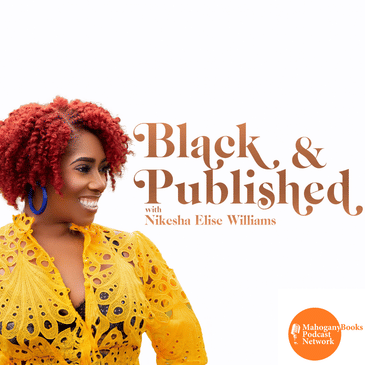

This week on Black and Published, Nikesha speaks with jarrett hill and Tre'vell Anderson, the authors of, Historically Black Phrases: From "I Ain't One of Your Little Friends" to "Who All Gon Be There?" Tre'vell and jarrett both have backgrounds in journalism and they are the hosts of the award-winning podcast FANTI. Their book chronicles the living language of Black people and how we bend a phrase to entertain, uplift, or sometimes to hurt and harm.
In our conversation, they discuss how they've found validation in their careers even when being written off as diversity hires. Plus, what they say job security looks like as a Black creative. And giving credit where credit is due to the marginalized community they say is often exploited and stolen from that they worked to honor through the pages of their book.
Follow the Show:
IG: @blkandpublished
Twitter: @BLKandPublished
Follow Me:
IG: @nikesha_elise
Twitter: @Nikesha_Elise
Website: www.newwrites.com
[00:00:00] We have grown up often being told that the ways
[00:00:03] that we naturally speak as Black people are wrong
[00:00:06] or they're unprofessional or they're not appropriate.
[00:00:09] Black language is real language that has real origin
[00:00:13] and has a real story and comes from somewhere
[00:00:16] and means something.
[00:00:17] What's good?
[00:00:18] I'm Nakeisha Elise Williams,
[00:00:20] and this is Black & Published,
[00:00:22] bringing you the journeys of writers, poets, playwrights,
[00:00:27] and storytellers of all kinds. Both have backgrounds in journalism. They are the host of the award-winning podcast, Fantai, and use their position in media to explore cultural stories at the intersections of the black and queer experience. How they found validation in their careers, even when being written off as diversity hires.
[00:01:40] Plus, what they say job security looks like
[00:01:43] as a black creative.
[00:01:45] And giving credit where credit is due. to doing Model United Nations. And in Model UN, you have to write these, like, very long research papers and whatnot. And the advisor for Model UN was like, oh, you actually kind of ate this. You should join the newspaper. And I was like, me? The newspaper?
[00:03:01] And so that's my villain origin story
[00:03:03] as it relates to being a writer.
[00:04:01] before there was an internet. And it was the first time of feeling like,
[00:04:02] oh, wow, this has some power to it.
[00:04:06] People are responding to it and having a feeling about it
[00:04:09] and asking questions about it.
[00:04:11] And I was like, there's something to this.
[00:04:13] This is interesting.
[00:04:14] TANAYA PATE-CHAPMAN, JR. So let's make this a full circle moment
[00:04:15] because I also was on my high school newspaper.
[00:04:17] My junior senior year and then went on to do broadcast journalism
[00:04:24] as a career for a bit. from people to then add in other people. Like, I started to see, like, the real power in it for myself as something that I wanted to try and embrace a little bit more and figure out what I could do with it. I think for me, knowing that I could write well has served me well in my career, because you can't tell me I can't write.
[00:05:41] You may not like what I wrote, okay?
[00:05:44] But you can't tell me it's bad,
[00:06:43] we're just gonna lean into that line of conversation. Because a lot of times journalism is the way
[00:06:47] that a lot of black writers find their way into writing.
[00:06:53] And I've said this numerous times on this podcast,
[00:06:55] whether you get an MFA or MA or graduate degree or not,
[00:06:58] it's just because it's a job with a check, right?
[00:07:01] That part.
[00:07:02] But even entering a space that black people have dominated
[00:07:06] in some ways, especially with black centered outlets, Tyler Perry movie that I was certain would be number one at the box office, and it was. Or doing extra work to, to... I started recapping Empire before that first couple episodes when, like, the ratings boom happened and I was telling them, I was like, y'all, I had screened it early. I was like, listen, Taraji P. Henson, Terrence Howard,
[00:08:20] baby, this is gonna be the best thing since sliced bread.
[00:08:22] And they were like, who? Taraji who?
[00:08:26] And I was like, what do you mean?
[00:08:27] She's Oscar nominated. Cut it out.
[00:09:25] fourth year and like was really feeling like I was not sure what I was because I didn't finish my degree and I wasn't working. So I was like, am I a producer? Am I a writer? Am I a this? Am I a that?
[00:09:31] But, you know, fast forward a number of years moving to Los Angeles, I started a podcast
[00:09:37] working in the post-production office of America's Next Top Model. And like that was our
[00:09:44] opportunity to have conversation about what was happening all the different other intersections in where we show up. Can we talk about why there's no such thing
[00:11:01] as job security, right?
[00:11:03] So why do you think that even with notoriety explicitly Black people. It is still a white supremacist institution, and so we will only ever be often regarded as the PC, the diversity hire, the extra, but not the foundation, not the core of a newsroom, right? And so because the
[00:12:22] foundation of our industry is white Like, because there's so much to it. The thing that was coming up for me toward the end of what Treville was saying was I get to do some work
[00:13:40] as a consultant outside of working as a journalist.
[00:13:44] And I was working with one of the major studios
[00:13:46] on doing some diversity, queer, non-binary, trans experience. And I basically take various pivotal moments in trans visibility since the beginning of moving images and juxtapose them against my own personal lived experience. And in particular, the last decade or so
[00:15:01] of my reporting on diversity in Hollywood.
[00:15:04] Um, and ultimately, I think it was important to do that book
[00:16:03] or they're unprofessional, or they're not appropriate. And we are forced in a lot of ways to code switch.
[00:16:06] And you speak one way around your friends,
[00:16:08] you speak a different way when you go to work,
[00:16:10] you know, all of that.
[00:16:11] And the reality is, and the interesting thing is,
[00:16:14] you know, in so many ways and at so many times,
[00:16:17] I'm seeing that the ways that we all were told
[00:16:20] that we couldn't speak in newsrooms,
[00:16:23] the ways that we were told
[00:16:23] that we couldn't speak in boardrooms,
[00:16:26] other people are speaking in those spaces, right after a nigga had gotten on my nerves, right? And, like, charge it to the game and all these other things, right, and I was, like, and I was using the hashtag historically Black phrases, right? And, like, I always thought that name was too long. I always thought it was gonna be something that I'd have to cut down or change. But, like, I thought when someone asked me in my comments if I was doing a book,
[00:17:40] like, oh, I should do a book.
[00:17:41] And so it started me really getting interested
[00:17:45] in, like, the things that come into this looking for that kind of validation,
[00:19:02] but I certainly got it along the way because this process has been seven
[00:19:05] years since like the first social media posts, right. of protests is when industries, including journalism and publishing, made a concerted effort to reach out to black writers, black creatives, to get their work. So what was the process of taking this book from proposal to two years later, where we're kind of seeing all of that support wane
[00:20:21] and things going back to what they were before.
[00:20:25] And now you have this cultural artifact this reckoning that was happening in publishing. We had, was it eight houses, you know, we're bidding on historically Black phrases. Um, and, you know, which, praise the Lord, shout out to us, right? Um, but that is an ex... that is a manifestation of, right, so many different publishing houses wanting something like this that was expressly
[00:21:43] Negroidean, right, on their books.
[00:22:42] that benefits largely people who don't look like us.
[00:22:44] And so, I think one of the things
[00:22:46] that has been really important for us
[00:22:52] is just making sure that we are centering blackness
[00:22:55] as much as possible throughout this book, right?
[00:22:59] Being as unconcerned as possible with the white gaze,
[00:23:01] even though we had a white woman,
[00:23:04] white person who purchased this book.
[00:23:06] Um, the definitions that we were writing,
[00:23:09] we had some back and forth with our editor friends to who all gonna be there. Jared and Treville deliver a snapshot of the language as black Americans are using it today to reveal the ethos behind how we live, love, welcome and warn, and sometimes hurt and harm each other with just our words.
[00:24:20] I'm gonna go with my favorite phrase in the book,
[00:24:24] which is a phrase that my speaker aims to differentiate someone's intellect and or awareness, usually their own, from that of a commoner with whom one is being confused for, usually said incredulously. Example. When the professor asked Nadi why their assignment was late,
[00:25:41] Nadi said their emotional support goldfish ate it.
[00:25:44] The professor responded,
[00:25:46] oh, so you think I'm boo-boo the fool? Similar to back in my day, this phrase is usually used by someone old or older than the spoken to. Whatever this phrase qualifies is probably antiquated as hell, usually preceded or followed by a longer, potentially more outdated statement or anecdote, which could very well be true, full of wisdom,
[00:27:01] or otherwise useful, but that is decidedly not guaranteed.
[00:27:04] Example.
[00:27:06]